
5 Signs Your Company Needs a Dedicated RevOps Hire
Not sure if you need a RevOps hire yet? Here are 5 clear signs your revenue engine has outgrown ad hoc processes, plus what to do next.
By Rishabh ·
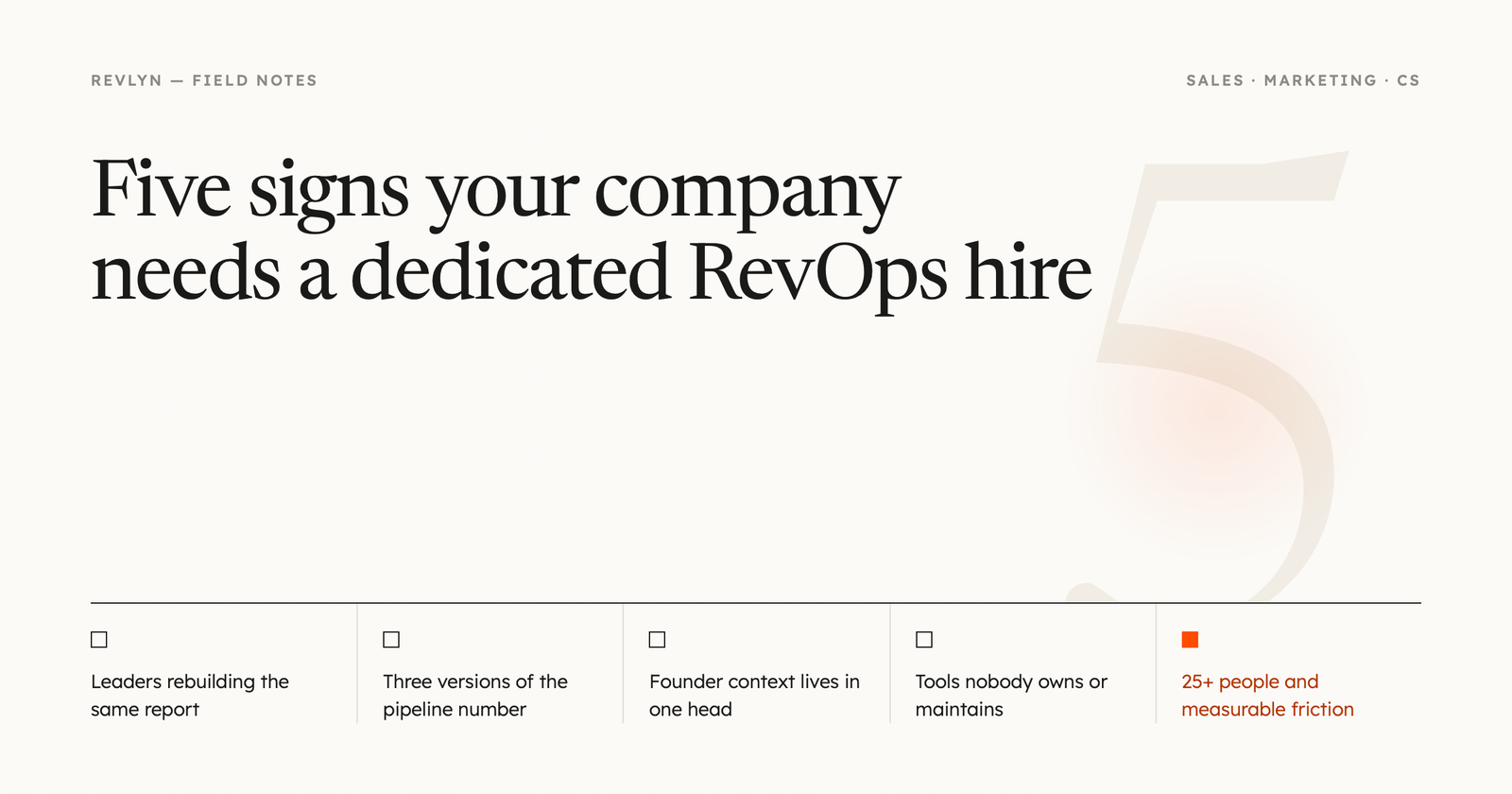
You probably need a dedicated RevOps hire if your sales, marketing, and customer success teams run on different data, your leaders spend more time reconciling spreadsheets than closing revenue, or you’ve outgrown founder-led sales without anyone systemizing the handoffs between teams. If two or more of these sound familiar, it’s time to act, not wait.
Here’s a scene that plays out at a lot of growing companies: your VP of Sales pulls a pipeline number from the CRM (customer relationship management software, the system that tracks every deal and customer interaction). Your CFO pulls a different number from a spreadsheet. Nobody agrees on what “qualified lead” even means anymore. Sound familiar?
That’s not a people problem. It’s a systems problem, and it usually means you’ve outgrown informal coordination between departments.
What Does a RevOps Hire Actually Do?
RevOps stands for Revenue Operations. It’s the function that aligns your sales, marketing, and customer success teams around one set of data, one set of processes, and one shared definition of how revenue actually gets made. The goal of RevOps is to break down departmental silos and create a single, unified approach to generating and growing revenue.
Instead of each department running its own tools, its own reports, and its own version of the truth, a RevOps hire (or team) owns the connective tissue between them. Think of it as the person who makes sure the baton doesn’t get dropped every time a deal moves from marketing to sales to customer success.
5 Signs You Need to Hire a Dedicated RevOps Person
1. Your leaders are doing data janitor work instead of leading
If your VP of Sales spends Monday mornings rebuilding the same Excel report because nobody trusts the CRM data, that’s a RevOps signal, plain and simple. Executive time is too expensive to spend on data cleanup that a system or a process should be handling automatically.
Your sales leader should be coaching reps and building playbooks, not burning 10 hours a week configuring workflows and chasing down numbers.
2. Sales, marketing, and CS can’t agree on the numbers
When your company can’t effectively upsell, cross-sell, manage renewals, or reduce churn, it’s usually because sales, marketing, and customer success aren’t on the same page. Departmental silos get in the way, and that friction shows up as compromised customer experience and lost revenue, not just internal annoyance.
If your teams are handing customers off like a bucket brigade instead of managing one continuous journey, that’s worth fixing before it costs you a renewal.
3. You’ve outgrown founder-led sales
When a founder is doing the selling, they hold all the context in their head: every customer, every deal, every quirky exception. That works fine at a tiny scale.
But once you’ve hired a sales leader and started building out a real team, that tribal knowledge needs to live in a system, not in one person’s memory. Without someone systemizing it, new hires reinvent the wheel and mistakes repeat.
4. Your tech stack has grown faster than your process
As companies scale, leaders often end up with a sprawling, disconnected tech stack. New hires bring in their own favorite tools, nobody owns integration, and pretty soon you’ve got five systems that don’t talk to each other.
Without a dedicated RevOps resource orchestrating a smooth handoff between tools and teams, your business will struggle to scale past this point. That’s not an opinion, it’s basically the definition of what happens when tooling outpaces process.
5. You’re past 25+ employees with distinct sales and marketing functions
Once you’ve got roughly 25 or more employees split across dedicated sales and marketing teams, and friction between those teams is causing measurable revenue loss (not just office tension), it’s usually time to bring on dedicated RevOps help. Waiting until it’s a full-blown crisis just makes the eventual fix more expensive.
Most companies bring in RevOps somewhere between Series A and Series C funding, depending on how complex their go-to-market motion has gotten. There’s no magic revenue number that triggers the hire. It’s really about whether operational complexity has outrun what your current team can coordinate informally.
Pro tip: before you post the job, run a quick funnel audit. Map out where deals actually get stuck or where data breaks down between systems. That audit tells you whether you need a generalist RevOps hire, a specialist (like someone focused purely on the tech stack), or a fractional consultant to start.
When Should You Hire Full-Time vs. Bring in Outside Help?
Not every company needs a full-time RevOps hire right away. Fractional RevOps leaders, who typically work 15-20 hours a week with a company, can be a smart middle step if you need strategic guidance but aren’t ready to commit to a full-time senior salary.
A hybrid approach works well for a lot of teams: bring in outside help to build the foundation (clean data, defined processes, a real reporting structure), then hire internally once the role is clearly scoped. Honestly, most botched first RevOps hires happen because the company tried to hire before anyone had actually defined what the job was supposed to fix.
Where Should RevOps Report?
This matters more than most founders think. A RevOps leader typically reports directly to the CRO (Chief Revenue Officer). In some cases, they report to the CFO or COO instead.
What you want to avoid is burying RevOps inside sales or marketing, where it inevitably ends up biased toward whichever department it sits under. RevOps only works if it can call out problems in every department, including the one it reports through.
A Quick Self-Check Before You Post the Job
- Can your leadership team agree on last quarter’s pipeline number without three separate spreadsheets?
- Does your CRM data get trusted enough that reps actually use it to prioritize their day?
- Is anyone currently “unofficially” doing RevOps work on top of their real job?
- Have you added tools in the last year that nobody fully owns or maintains?
- Are handoffs between marketing, sales, and customer success documented anywhere?
If you answered “no” to two or more of these, that’s your signal.
Frequently asked
Do we need a RevOps hire even if we’re a small startup?
Probably not yet. At the earliest stages, revenue teams are usually small enough that founders or early GTM leaders can manage operations without a dedicated hire.
What’s the difference between RevOps and sales operations?
Sales ops focuses narrowly on the sales team’s tools and process. RevOps sits above that, unifying sales, marketing, and customer success into one shared system and one shared set of metrics.
How fast can a RevOps hire show impact?
It varies a lot by company, but the fastest wins usually come from fixing data trust issues and clarifying handoffs between teams, not from big strategic overhauls in month one.
Should our first RevOps hire be a generalist or a specialist?
Start with a generalist. Once you’ve got 25+ employees across distinct GTM teams, that’s usually when it makes sense to start splitting the role into specialists for enablement, systems, and analytics.
What happens if we wait too long to hire?
Waiting too long tends to mean sales leaders doing manual reporting instead of coaching, more data conflicts between departments, and a tech stack nobody fully owns. None of that fixes itself.
If you’re staring at two or three of these signs right now and not sure whether to hire, build a fractional bridge, or fix your process first, that’s exactly the kind of question worth a real conversation. Book a RevOps diagnostic call with Revlyn and we’ll help you figure out what your revenue engine actually needs before you write the job description.
Want a second pair of eyes on your CRM?
Tell us what feels messy today. A first conversation is for understanding your situation, not pushing a package.
Book a discovery call