
So let's skip
the sales pitch.
Every HubSpot implementation page reads the same: certified partners, proven methodology, dedicated success manager. You've seen it ten times today. Below is the same story told a different way, four moments you're probably living this week, six weeks of build shown layer by layer, and the six documents you walk away owning.
Read it if the pattern above sounds familiar. Skip to Pricing if it doesn't.

You probably didn't come here
to read another homepage.
You came here because one of these four things happened this week. Pick the one that felt closest.
A CRM you'll actually
want to open on Monday.
Architecture, not a checklist
We design your CRM around how your revenue actually moves, not how a template thinks it should.
Clean data from day one
Every record deduped, normalised, and mapped. No 'we'll fix it later' technical debt.
Reports leaders trust
Dashboards that answer real questions: where is pipeline stuck, what's converting, what to do next.
A team that keeps using it
Enablement, playbooks, and training so HubSpot isn't just installed, it's adopted.
The eight layers of a
healthy HubSpot.
We build every implementation on the same eight-layer foundation. Skip one, and cracks appear six months later.
Six weeks, watched
layer by layer.
Most implementation timelines are a Gantt chart nobody trusts. Ours is a portal you can see assembling in real time. Scroll the weeks, watch it come together.
Before we touch a workflow, we map how your business actually sells. Objects, lifecycle stages, and the two or three fields that decide every pipeline meeting.
Properties get named, deduped, and grouped. Legacy fields are archived, not deleted, so history stays intact. The portal starts to feel like it was designed on purpose.
Workflows that move deals, assign owners, and update close dates from activity, not vibes. Every automation is documented so the next hire can read it.
Dashboards for the three people who look at them: rep, manager, board. Numbers reconcile. The Sheets shadow CRM quietly retires itself.
Loom walkthroughs, in-portal guidance, and a onboarding path a new rep can finish in a day. Adoption stops being a training problem.
A runbook, a change log, and a monthly rhythm so the portal keeps behaving after we leave. Or, if you want, we stay on and run it with you.
What actually happens,
week by week.
Discovery & audit
- →GTM interviews (sales, marketing, CS, ops)
- →Current-state audit (portal, data, stack)
- →Revenue architecture v1 signed off
Design & data
- →Object & property model
- →Lifecycle stages + criteria
- →Data migration plan + dedupe rules
Build core
- →Pipelines, stages, automations
- →Deal & contact routing
- →Email, sequences, templates
Integrations & AI
- →Warehouse / product / billing wiring
- →Enrichment + routing agents
- →Slack / Gong / calendar hooks
Reporting & QA
- →Exec & team dashboards
- →Attribution model
- →End-to-end QA scenarios
Launch & enable
- →Team training + playbooks
- →Runbooks + governance
- →30-day support runway
Before we build,
we draw.
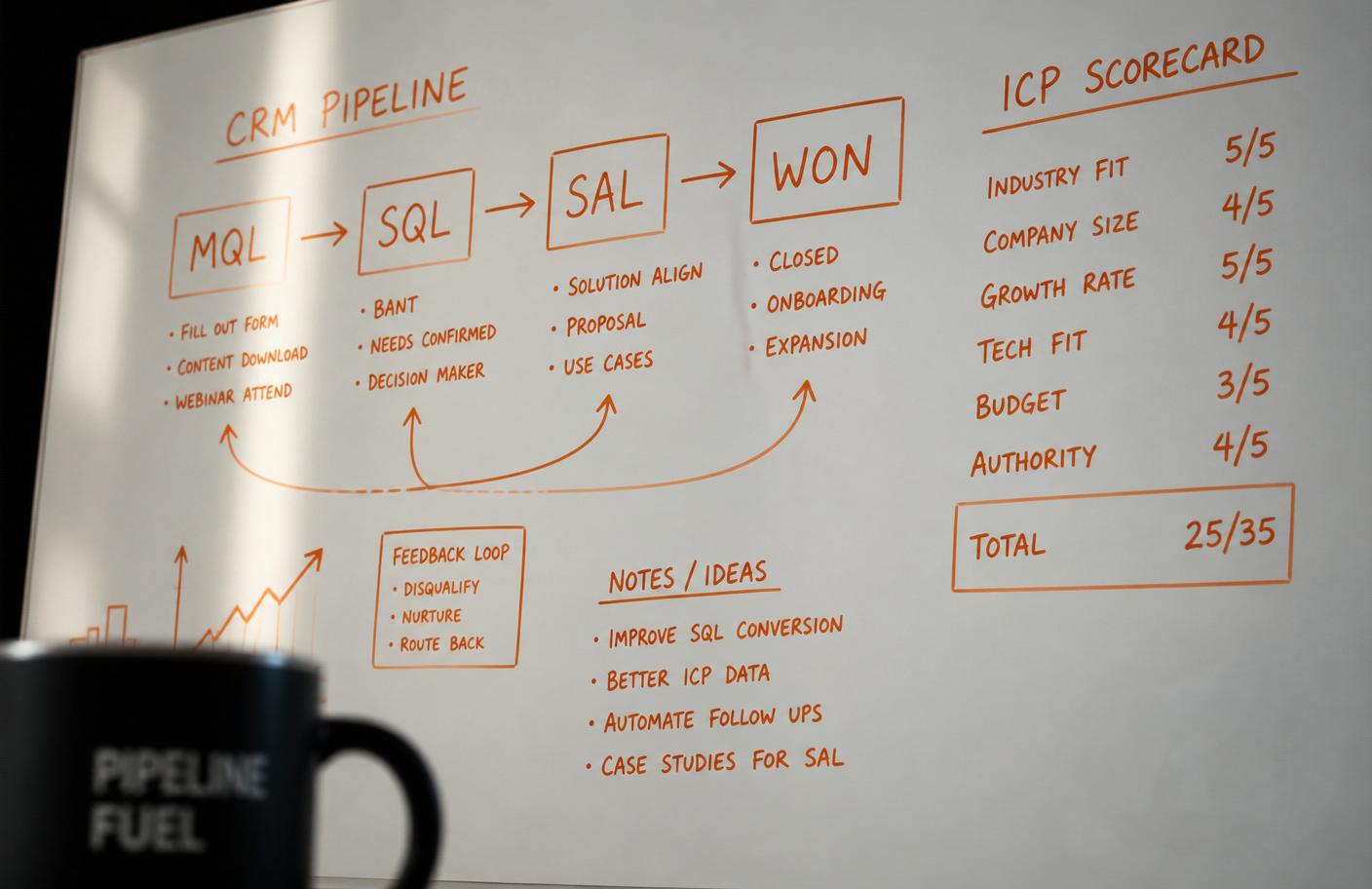
Every engagement starts with a Revenue Architecture document, a single page that shows your funnel, your stages, your data flow, and your decision points. Your leadership team signs it. Then we build it.
- ✓Funnel + lifecycle map
- ✓Object & property inventory
- ✓Data flow across systems
- ✓Ownership & SLA matrix
- ✓Reporting question tree
Six artifacts,
not a slide deck.
Every implementation ends with the same six documents. They belong to you, they live in your Notion, and they're written so the next hire can read them without a meeting.
Object model & lifecycle map
- Contact → Lead → MQL → SQL → Opp
- Company hierarchy rules
- Stage exit criteria
- Ownership matrix
Property dictionary
- 247 fields, defined
- Owner, source, retention
- Deprecated fields archived
- Change log by quarter
Automation inventory
- Deal routing by ARR band
- Close-date auto-updates
- MQL scoring model
- Slack alerts for stalls
Reports the board actually opens
- Pipeline coverage 3× view
- Rep-level activity vs quota
- Cohort retention
- Forecast vs commit
Enablement library
- Rep onboarding in a day
- Manager weekly rhythm
- Admin how-tos
- Every workflow walked through
The 'when it breaks' book
- Common errors & fixes
- Escalation contacts
- Monthly maintenance list
- Change-request template
Not a portal.
An operating system.
Architecture
- Revenue arch doc
- Object model
- Stage criteria
- SLA matrix
Data
- Migration plan
- Dedupe rules
- Normalisation
- Validation tests
Automation
- Deal + contact routing
- Lifecycle workflows
- Sequences
- Task logic
Reporting
- Exec dashboard
- Team dashboards
- Attribution
- Forecast view
Integrations
- Warehouse sync
- Product events
- Billing
- Support / calendar
Enablement
- Playbooks
- Training sessions
- Runbooks
- 30-day support
Every signal, in the right place,
at the right time.
What changes in 6 weeks.
Right fit, wrong fit ,
we'd rather say it upfront.
- →You're rolling out HubSpot for the first time
- →You're migrating from Salesforce, Pipedrive or Zoho
- →Your current HubSpot is a mess and needs a rebuild
- →You want AI in the workflow, not as a bolt-on
- ·You want a template dropped in and walked away from
- ·You need a cheapest-possible admin, not a system
- ·You don't have leadership time for one workshop a week
Fixed scope.
Fixed price. No surprises.
Single hub, single pipeline, up to 3 integrations. Ideal for early-stage teams.
- Marketing or Sales Hub
- Up to 3 integrations
- 1 pipeline, 1 dashboard set
- 2 training sessions
Full multi-hub build with warehouse, AI and attribution. Our most popular.
- Marketing + Sales + Service
- Warehouse + product events
- AI enrichment & routing
- Attribution & forecasting
Multi-region, multi-entity, or Salesforce → HubSpot migrations.
- Multi-brand / multi-region
- Complex migration
- Custom objects at scale
- Change management
Every engagement starts with a $2K discovery. If we build with you, that's credited toward the project.
The things
people ask us.
Is 6 weeks realistic?+
For 90% of implementations, yes. We move fast because we've done this many times and we require a signed architecture before we build. Complex migrations (Salesforce, multi-region) take 8–10 weeks, we'll scope honestly.
What do we need from our side?+
One executive sponsor, one ops lead, and ~4 hours a week from your GTM leaders for the first three weeks. Less after that.
Do you work with existing partners or admins?+
Yes. We often run alongside internal ops teams or handle the heavy build so your admin can focus on day-to-day.
What happens after launch?+
You get 30 days of support to shake out issues. After that, most teams roll into HubSpot as a Service so we keep operating the system with you.
Do you rebuild bad implementations?+
Constantly. About a third of our projects are rebuilds. We'll audit what's salvageable before proposing scope.
Let's build the
last HubSpot you'll ever set up.
One workshop is all it takes to see the shape of your rebuild. It's free, and there's no obligation.