
GTM Motion Types Explained: PLG vs Sales-Led vs Hybrid
Confused about GTM motions? Learn what PLG, sales-led, and hybrid go-to-market motions actually mean, and how to pick the right one for your stage.
By Kartik Mishra, Revlyn ·
What Is a GTM Motion? PLG vs. Sales-Led vs. Hybrid Explained
If you’ve spent any time around SaaS founders or investors, you’ve probably heard someone say “what’s your GTM motion?” like it’s obvious. It isn’t, especially if you’re building your first company or your first revenue team.
The term sounds more complicated than it is. Once you see the three main flavors side by side, picking one (or blending two) gets a lot less scary.
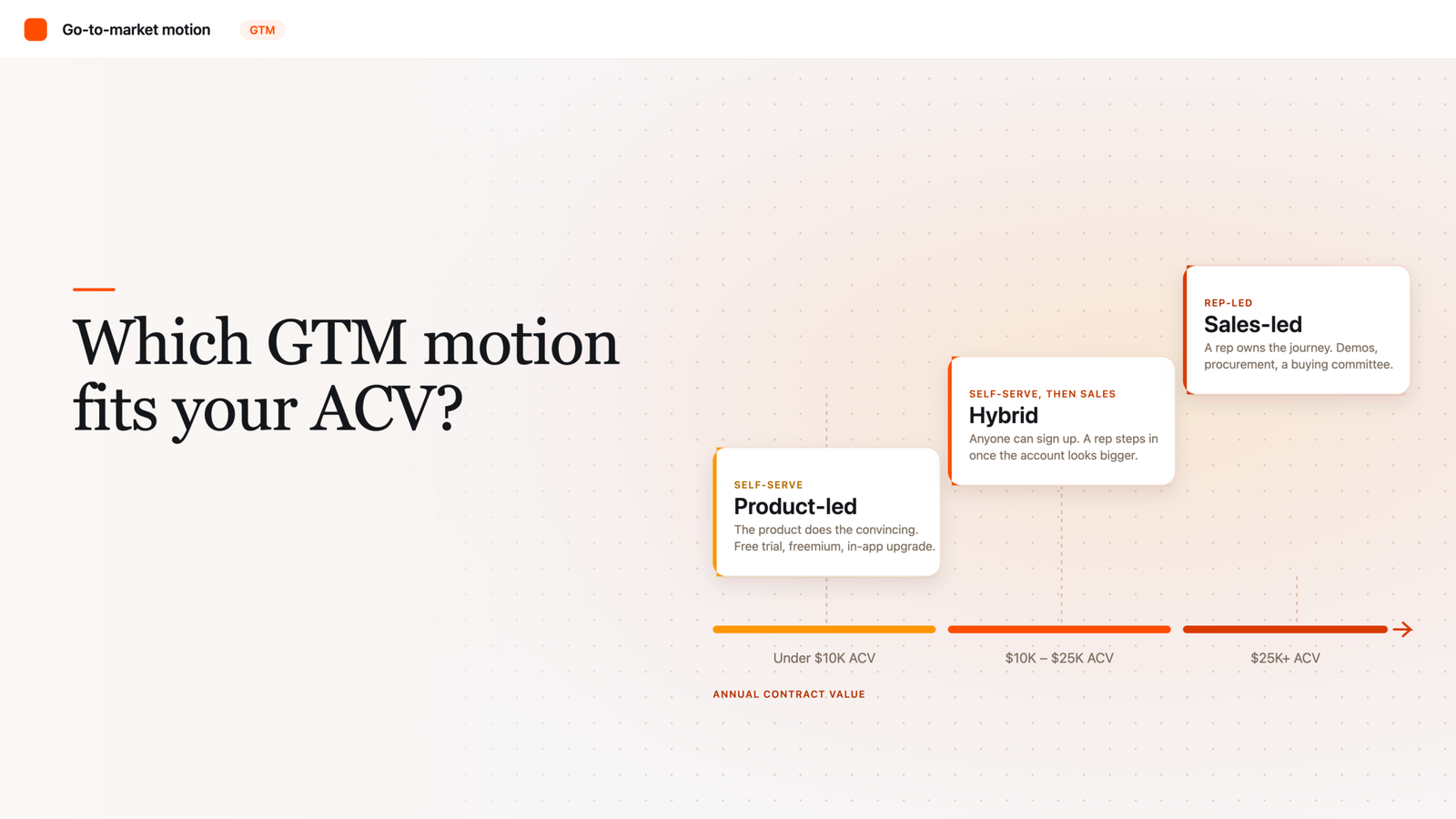
A GTM (go-to-market) motion is the repeatable way a company gets its product in front of buyers and turns them into paying customers. The three core types are product-led (the product sells itself through self-serve trials), sales-led (reps drive the deal), and hybrid, which blends both depending on deal size and buyer type.
What Is a GTM Motion, Exactly?
A go-to-market motion is basically your company’s answer to three questions: who buys, how do they find out about you, and who actually closes the deal. Not a marketing plan, not a sales script, but the underlying operating model that shapes both.
Most early-stage founders don’t choose a motion on purpose. They copy whatever the last company they worked at did, or whatever’s trending on LinkedIn that week. That’s a mistake, because the wrong motion for your price point and buyer type can quietly stall growth for years.
What Is a Product-Led Growth (PLG) Motion?
Product-led growth is a go-to-market strategy where the product itself is the primary driver of acquisition, activation, and expansion, not a salesperson. Users try the product themselves, usually through a free trial or a freemium plan (a free, limited version of the product), experience value, and then upgrade or expand on their own.
The term was coined by Blake Bartlett at OpenView back in 2016, and it’s since become an umbrella for tactics like freemium models, self-guided product tours, and in-app upgrade prompts. Think Slack or Dropbox: you didn’t sit through a sales pitch before you started using them. You just signed up and started working.
One reason PLG caught on so fast is cost efficiency. A product-led strategy can reduce customer acquisition cost by taking pressure off the sales team, since the product itself is doing a lot of the convincing. OpenView has also found that leading product-led growth companies grow significantly faster year over year than traditional SaaS companies relying purely on sales.
But PLG isn’t free. It only works if the product delivers value fast, with little to no setup, and if a single user can get real benefit without needing five other people to sign off.
What Is a Sales-Led GTM Motion?
Sales-led growth flips the model: a human being, usually an account executive or sales development rep, owns most of the buyer’s journey. Instead of a free trial doing the convincing, sales and marketing create the need for the product and then walk a prospect through demos, proposals, and negotiation.
This motion tends to fit complex products with higher price tags and multiple decision-makers. Industry benchmarks generally put sales-led growth as the better fit for deals above roughly $25,000 in annual contract value (ACV, the yearly revenue a customer contract is worth), especially when a buying committee, not just one person, has to approve the purchase.
If you’re selling something that touches security reviews, procurement, or multiple departments, a self-serve trial usually can’t close that deal on its own. That’s where a rep earns their keep.
What Is a Hybrid GTM Motion, and Why Is It So Common Now?
A hybrid motion pairs sales-led and product-led strategies into a single go-to-market approach, aiming to capture the efficiency of self-serve while still being able to land larger, more complex accounts. In practice, that often means self-serve signup for smaller customers and a sales team stepping in once an account shows signs of being a bigger opportunity.
This isn’t a niche approach anymore. Research from McKinsey points out that the lines between PLG and sales-led are already blurring: pure-play PLG companies are hiring sales teams to serve enterprise accounts, while traditional sales-led companies are building product-led experiences to win over smaller customers. Companies that pull off this blend well can see genuinely differentiated returns compared to sticking with one motion alone.
Honestly, most companies that claim to be “pure PLG” past a certain size aren’t. Once you’re closing six-figure enterprise deals, somebody in a sales seat is involved somewhere in that process, even if the first touch was self-serve.
How Do You Pick the Right GTM Motion for Your Business?
There’s no universal right answer here, but there is a fairly reliable way to work through the decision. Run through these steps before you commit to a motion:
- Know your buyer, not just your market. Before anything else, get specific about who you’re actually selling to. This is your ICP (ideal customer profile), and if you haven’t nailed it down yet, it’s worth reading through what an ICP is and why it matters before you go further.
- Check your average contract value. Lower ACV products (roughly under $10K annually) tend to favor product-led motions. Higher ACV, complex deals tend to need sales involvement.
- Map the buying process. Is this a single-user decision, or does it need sign-off from IT, finance, and a department head? More stakeholders usually means more need for a human guiding the deal.
- Measure time-to-value. Can a user get real value in minutes, or does it take weeks of setup and training? Fast time-to-value supports self-serve; slow time-to-value usually needs sales-assisted onboarding.
- Size the addressable market for each segment. Understanding your TAM, SAM, and SOM (the total, serviceable, and obtainable market) helps you see whether your best opportunity sits in a high-volume, lower-price segment or a smaller, higher-price one, which points you toward PLG, sales-led, or a hybrid split between them.
- Validate with real usage data, not opinions. If self-serve signups are converting on their own, don’t force a sales layer on top of something that’s already working.
Pro tip: don’t pick a motion because it sounds modern. Pick it because your ACV, buyer complexity, and time-to-value point you there, then adjust as you scale.
Frequently asked
Is PLG always cheaper than sales-led growth?
Usually, yes, on a per-customer basis, since acquisition costs in a PLG motion don’t scale up proportionally with each new customer the way sales headcount does. But cheap doesn’t always mean better if your product needs a human to close bigger deals.
Can a small startup run a hybrid motion from day one?
Technically yes, but it’s rarely a good idea. Most companies start with one motion, prove it works, and layer in the second once they see a clear signal (like inbound signups from larger accounts) that justifies adding sales or self-serve on top.
Does a hybrid motion mean I need two separate teams?
Not necessarily two full teams, but you do need clear rules for handoffs. Segment by company size or by buying signal, and make sure everyone agrees on when a self-serve user gets routed to a rep.
What’s the difference between a GTM motion and a GTM strategy?
A GTM strategy is the bigger picture: your positioning, pricing, and target market. A GTM motion is the operational engine underneath it, specifically how deals actually get sourced and closed.
How do I know if my GTM motion is broken?
Watch for declining win rates, rising customer acquisition costs, or a sales team spending most of its time on deals too small to justify the effort. Any of those are signs it’s time to revisit the motion, not just the tactics underneath it.
Practical CRM notes, once a month.
HubSpot tips, RevOps playbooks, and what is working for growing revenue teams. Short, useful, and never salesy.