
RevOps vs. CRO: How the Roles Actually Relate
RevOps and a Chief Revenue Officer aren’t the same thing. Here’s how the function and the executive role fit together, and which one you need first.
By Kartik Mishra, Revlyn ·
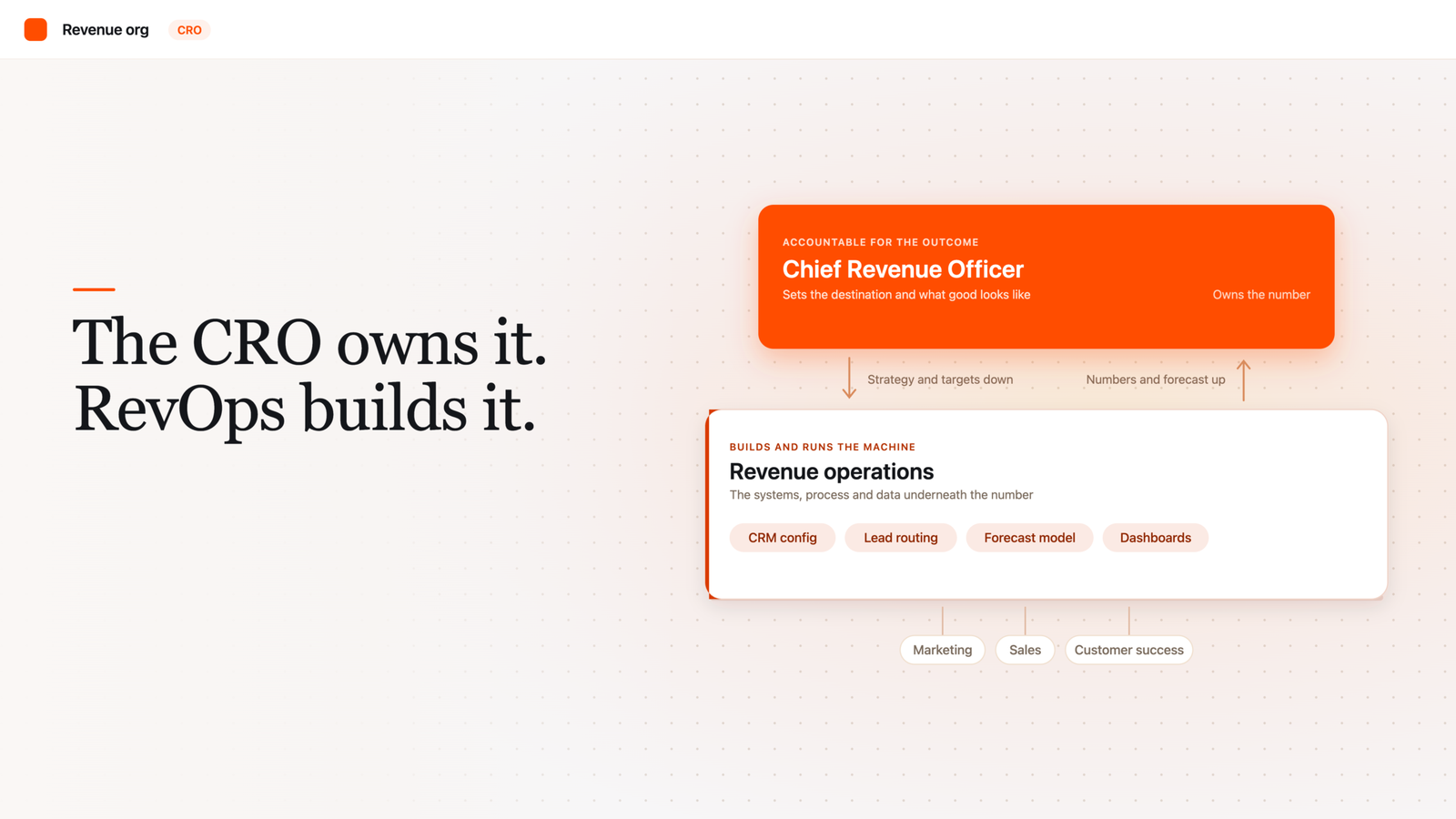
RevOps is a function that aligns your sales, marketing, and customer success teams around shared processes, data, and tools. A CRO (Chief Revenue Officer) is the executive who owns revenue outcomes across those same teams. RevOps is the system; the CRO is the person accountable for what that system produces.
If you’re a founder or early revenue leader, you’ve probably heard both terms thrown around in the same breath, sometimes even as if they’re interchangeable. They’re not. Mixing them up can lead you to hire the wrong person, build the wrong reporting line, or expect one role to do a job it was never designed for.
What Is RevOps, Exactly?
Revenue Operations (RevOps) is the function responsible for connecting the systems, processes, and data behind your sales, marketing, and customer success teams so they work off the same playbook instead of three different ones. If you want the fuller picture of what this function covers day to day, our beginner’s guide to RevOps walks through it from the ground up.
RevOps people live in the weeds: CRM configuration, lead routing, forecasting models, reporting dashboards. They’re the ones who notice when marketing counts a “qualified lead” differently than sales does, and they fix it.
What Is a Chief Revenue Officer (CRO)?
A Chief Revenue Officer (CRO) is a C-suite executive responsible for all revenue-generating functions in a company, typically sales, marketing, and customer success. Salesforce describes the CRO as responsible for every process that generates revenue in an organization, connecting functions that range from marketing and sales to customer success, pricing, and revenue operations itself.
The CRO title showed up mostly in tech and SaaS companies, originally as a way to unify departments that used to operate in silos. That’s a useful thing to know, because it tells you the role was invented to solve a coordination problem, not just to add another executive seat.
A CRO isn’t the same as a VP of Sales, even though the two roles sound similar on paper. A VP of Sales is focused purely on sales performance, while a CRO’s mandate stretches across marketing, customer success, and pricing decisions too. Some companies also use a Chief Sales Officer (CSO) title, but that role focuses specifically on the sales function and closing revenue, while a CRO’s broader mandate includes marketing, customer success, and revenue operations on top of sales.
So How Do RevOps and the CRO Actually Relate?
Here’s the simplest way to think about it: RevOps builds and runs the machine. The CRO is accountable for what the machine produces.
In a lot of organizations, RevOps reports directly into the CRO. Having RevOps report to the CRO is one of the most common structures in the industry, and the Head or VP of RevOps often ends up functioning as the CRO’s right hand, translating strategy into the systems and processes that make it real. That’s not a coincidence. A CRO needs oversight across every revenue function, and RevOps is the operational layer that makes that oversight possible instead of just aspirational.
Think of it this way: the CRO sets the destination and decides what “good” looks like for growth. RevOps builds the roads, checks the fuel gauges, and flags when a wheel is about to fall off. Neither one works well without the other, but they’re clearly not the same job.
That said, this reporting relationship isn’t universal, and it depends heavily on company size and stage. We cover the different ways RevOps can be structured, including when it should sit under a CRO versus a CEO or COO, in our post on RevOps org structure models.
Why Do Companies Confuse the Two?
Honestly, most of the confusion comes from job postings, not from the roles themselves. RevOps jobs sometimes get listed under titles like Chief Revenue Officer or VP of Revenue Operations, which blurs the line for anyone browsing job boards trying to understand the field.
Add to that the fact that a Director of RevOps and a CRO both care about “revenue,” and it’s easy to see why people flatten the two into one idea. But their approaches differ: a CRO focuses on revenue strategy, go-to-market planning, and directly leading revenue-generating teams, while a Director of RevOps focuses on the operational infrastructure, the processes, systems, data, and analytics, that let those teams actually execute. In most companies, the Director of RevOps reports up to the CRO or an equivalent executive, not the other way around.
Do You Need a CRO, a RevOps Hire, or Both?
Most early-stage companies don’t need a CRO. They need someone fixing the operational mess first. Here’s a rough way to think through it:
- You’re pre-Series B and sales/marketing keep tripping over each other. Start with a RevOps hire, not an executive. You need someone untangling CRM data and lead handoffs before you need someone setting revenue strategy at the board level.
- You already have a functioning RevOps layer but no single owner of revenue outcomes. This is often the point where a CRO makes sense, since the operational foundation (data, systems, forecast rhythm) is already there for an executive to actually use.
- Your sales, marketing, and customer success leaders don’t trust each other’s numbers. That’s a RevOps problem first. A CRO without reliable data underneath them is just another executive guessing.
- You’re scaling past the point where the CEO can manage revenue alignment personally. This is a classic trigger for adding a CRO, especially once ARR and headcount both cross a threshold where cross-functional friction becomes the actual bottleneck, not lack of demand.
Pro tip: if you’re not sure whether your company has hit the tipping point for a dedicated operational hire, our post on signs your company needs a dedicated RevOps hire has a more detailed checklist.
One more thing worth saying plainly: a CRO hired into a company with no RevOps foundation is set up to fail before they even start. That’s part of why CRO tenure tends to run short. A recent analysis placed average CRO tenure somewhere between 17 and 25 months, and other industry commentary points to an even blunter figure, an average CRO lifespan of around 18 months, compared to roughly 7 years for CEOs and 5 for CFOs. A lot of that comes down to expectations versus support: CFOs inherit established financial systems, but CROs are often handed a bloated, inefficient revenue engine and told to make it work, without a proven playbook to lean on.
That’s not a knock on the people taking these jobs. It’s a structural problem, and RevOps is usually the fix.
Frequently asked
Does RevOps replace the need for a CRO?
No. RevOps handles the operational layer (systems, data, process), while a CRO owns the strategic accountability for revenue outcomes across teams. Most growing companies eventually need both, just not necessarily at the same time.
Who does RevOps report to if there’s no CRO yet?
It varies by company. RevOps commonly reports to a CEO, COO, or CRO depending on stage and structure, and our post on RevOps org structure breaks down when each model makes sense.
Is a CRO the same as a VP of Sales with a bigger title?
Not really. A VP of Sales is focused only on sales, while a CRO’s mandate spans marketing, customer success, and pricing decisions as well. Some companies use “CRO” loosely, but the intended scope is meaningfully broader.
Can one person be both the RevOps lead and the CRO?
In very early-stage companies, yes, it’s common for one person to wear both hats temporarily. As the company scales, though, the operational workload and the strategic workload usually get too big for one seat.
Why do so many CROs leave within two years?
A big part of it is inheriting broken systems with no existing playbook to fix them, which is a very different situation than a CFO or CEO typically walks into. Building out RevOps before or alongside a CRO hire is one of the more practical ways to avoid that trap.
Practical CRM notes, once a month.
HubSpot tips, RevOps playbooks, and what is working for growing revenue teams. Short, useful, and never salesy.